

Safety in Hoisting Begins in Design
Safety in hoisting often focuses on human behaviors. In reality, human behaviors are just contributors. The decision making that starts on a drawing board or in CAD that moves on through the buyer and risk managers decision making is where safety is accomplished. Safety should always be engineered out first. This doesn’t happen in case after case. I have some examples in Skip Pans today and how they are selected and then used in the field. It can be a bit shocking if you simply step back. I find myself asking, “Do people really do this?” Yes. Yes they do. And Managers and professionals watch it as if it isn’t a problem.
Load Containers Need to Retain the Load
I was on a jobsite recently and saw a Crane Skip Pan that is pretty poorly designed. It’s clunky as a starting point. But when you look at it, it really has about 60% of it’s volume above the front lip of the skip pan. The result is that items are encouraged to be loaded up well above the structure in the front that will retain the items within. The side and rear height really serves no purpose other than leading to unsafe behaviors. When I have conversations with these equipment managers, they’ll cite standards like this being a 4 yard skip pan. That’s a fine statistic, but is it only safely managing to retain 2 yards of goods? The rest is staying in place with hopes instead of welded steel?
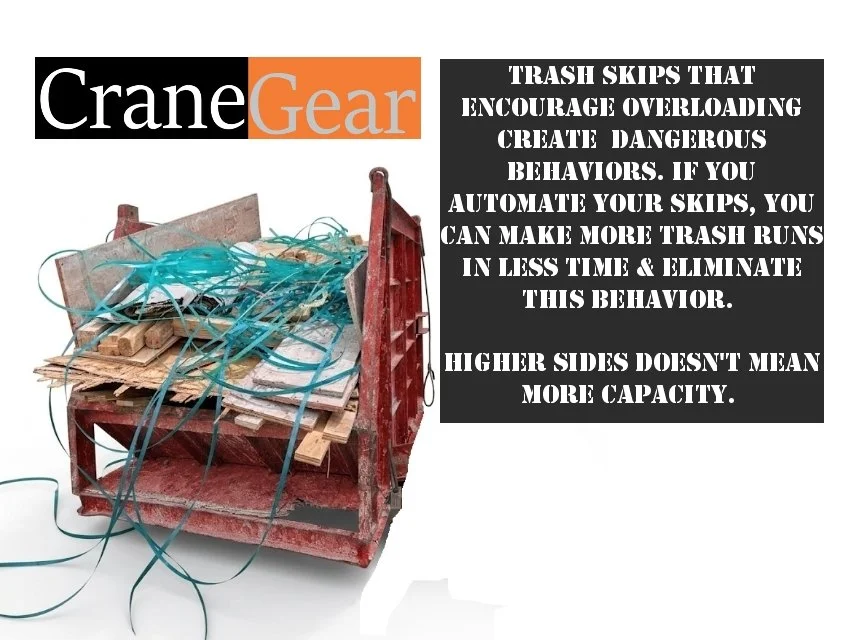
Poorly designed Crane Skip Pan overloaded due to tall sides relative to the front lip.
Available in Canada
The US isn’t the only place that uses this practice. In Canada I see these all over the place from various manufacturers. People not used to safer alternatives focus on an unsafe option as the right choice financially and operationally. But these fly off of buildings 40 stories in the air. If you lose one item that hits one person, what’s the cost? Mentally? Emotionally? Financially? If you harm someone that can’t work again with something this egregious as an error in judgement, what would the financial toll be in order to save $1000 on a properly designed bin? It used to be that Load Containers weren’t addressed in BC and across much of North America frankly. In 2025 they became covered by the current ASME B30.20 Below the Hook 2025. Employers are responsible for keeping up with the standards and ensuring a safe work place. Allowing hoisting like this is not keeping up with a safe work place. Even if no one will cite you, we can all recognize that this isn’t safe. Here I’m showing you that the behavior extends from Florida to Vancouver BC with these pictures.
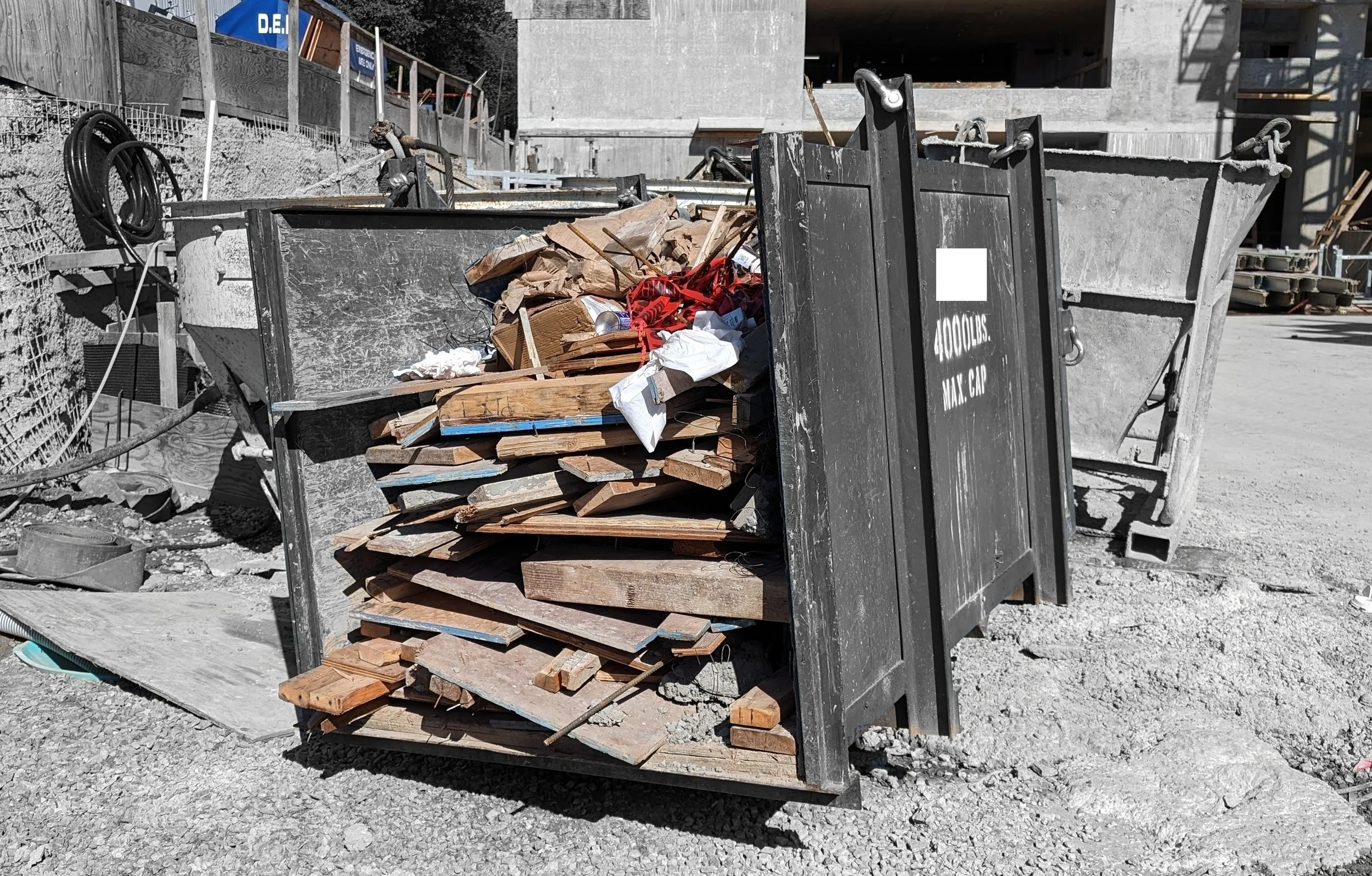
Unsafe Crane Trash Skip found commonly across British Columbia of various designs.
The Risks of Poor Design for Contractors
ASME B30.20 2025 lays out the responsibility of Owners and Operators. If you have a bin rated at four yards and the one side is fully opened, as and Owner, how do you expect to meet this requirement of the ASME?
20-1.4.3.1 (2) Verifying that the lifting device has the necessary rated load to perform the proposed lifting operation in the planned configuration.
If an incident occurs and a Expert Witness shows up to have an attorney ask you questions, one of them will be, “Did you load up the 4 yards of common products loaded in the field to ensure the bin would safely retain the claimed 4 yards of item prior to delivering it to the field?” The answer will be no and it will be devastating in terms of liability. Contractors need to consider their deeper responsibilities when selecting equipment.
And if you are the crane operator, rigger, or the lift director, paragraph 3 of the Responsibilities of the Operator in the ASME state,
(d) Understanding the lifting devices functions and limitation as well as it’s particular operating characteristics.
If you have overloaded the front lip of the bin, the lawyer will ask you in a deposition, “Can you point to the place in the supplied manual that indicates you can use the space over the front lip as loading space?” When you answer that you can’t, your employer is going to face financial consequences.
Everyone here has responsibilities to not use unsafe equipment, including doing so unsafely.
Proper Side Ratios
The sides of Crane Skip Pans being excessively tall is a liability and poor practice. having to lift too high is an unsafe work practice for backs and shoulders. We should want to lift around waist high and limit much beyond this.
We should limit wall heights relative to the front lip also so the users don’t infer that they could load more. If the side walls are limited, items over the sides and back are more readily recognized as unsafe to overload.
Our bins are reasonable in these regards. In some cases we like to keep the front lip to 19 or 20 inches so a wheel barrow can be loaded into the skip pans. But even when we build 10.4 yard bins, the front lips are tall enough to retain soils as a mound.
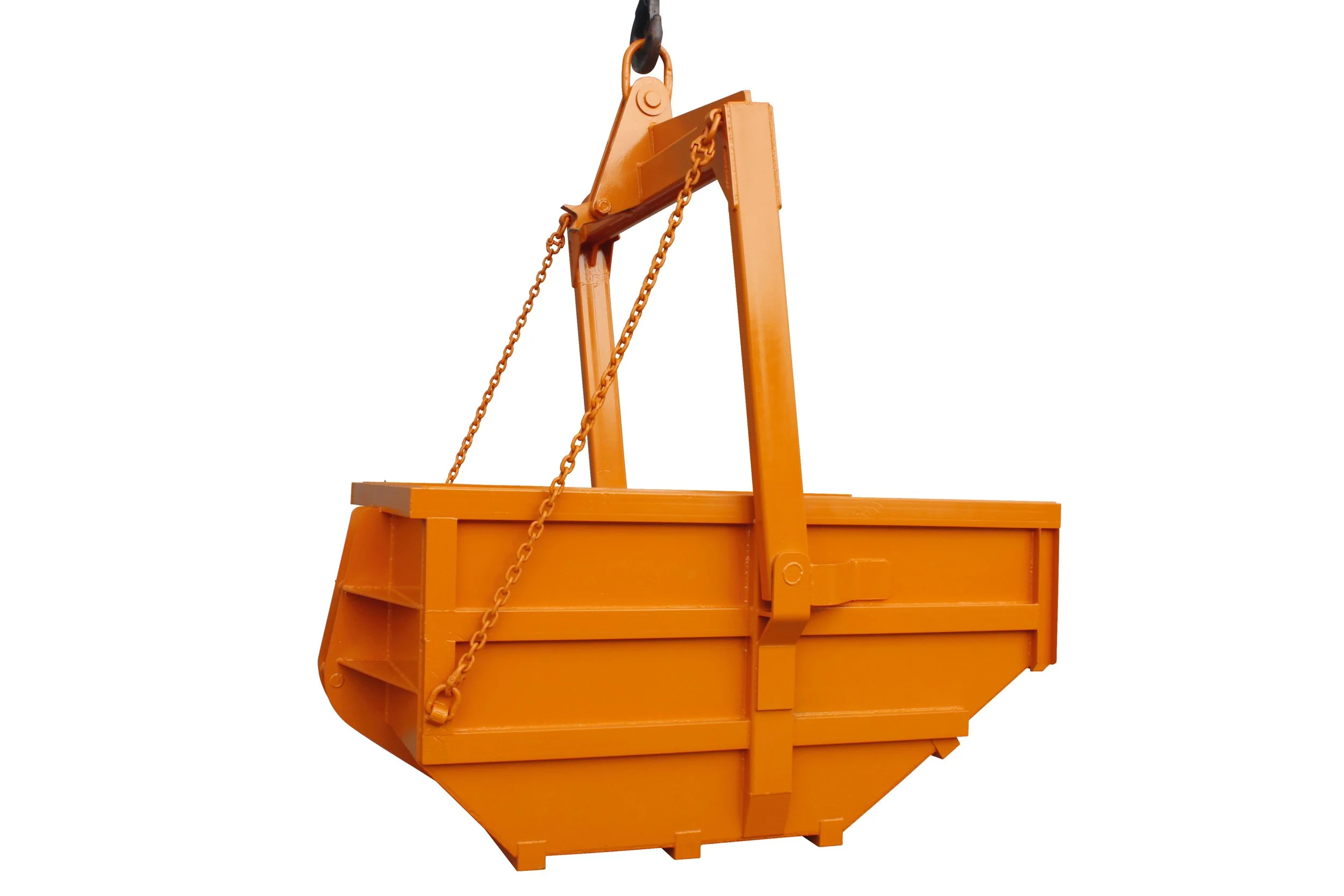
Eichigner 10.4 Yard skip pan as a profile
Automated Dumping Action
Automated Dumping in a Skip Pan has the effect of speeding up the operations. If you can send away a Skip Pan to be emptied and the rigger does not need to follow, they can work on the next operation. So instead of overloading the bin due to how little time the crane has for the work, you create a safer situation by sending the crane to get the task done alone instead of having to wait for an available rigger to function latches or change sling configurations. You end up with a safer jobsite and faster completion of duties in every case due to the automation.
Crane Skip Pan by Eichinger in orange that opens and closes Automatically without a human touching it.
Crane Skip Pan Safety Evolved
It’s time we evolve Crane Skip Pan Safety across North America. Eichinger is the company to deliver these innovations from CraneGear.net . We have stock as of today in Seattle and can deliver. If we have to ship them from Germany, you can realize great savings on volume purchases. We’d door to door ship them and you’ll have new solutions ready to serve your people for the next 20+ years without the risks of poor designs. Let’s mitigate your risk and get everyone home. Show your riggers this solution and watch their eyes light up. If you don’t see what it’s all about, ask your crane crews. They’ll let you know. This is a solution designed by crane people with specific intentions of making it fast and safe.